The Witcher 3: Wild Hunt – Detailed Review, Story, Gameplay, Open World and Features
The Witcher 3: Wild Hunt is an acclaimed open-world action RPG developed by CD PROJEKT RED. Follow Geralt of Rivia across a vast fantasy world filled with monsters, dangerous quests, political conflicts and memorable characters. Discover the story, combat system, exploration, character progression, expansions and features that make The Witcher 3 a landmark RPG experience.
 NorthGames
The Witcher 3: Wild Hunt Detailed Review
The Witcher 3: Wild Hunt is an open-world action role-playing game developed and published by CD PROJEKT RED. Originally released in 2015, the game takes players into a huge fantasy world inspired by Slavic mythology, medieval Europe and the novels of Andrzej Sapkowski.
Players take control of Geralt of Rivia, a professional monster hunter known as a Witcher. Geralt travels across war-torn regions searching for Ciri, a young woman connected to him through destiny and pursued by the mysterious Wild Hunt.
Although the main story provides a clear objective, The Witcher 3 is much more than a straightforward adventure. Its enormous world is filled with side quests, monster contracts, treasure hunts, villages, cities, characters and decisions that can produce different consequences.
The combination of storytelling, exploration, combat and role-playing systems is the foundation of the game's enduring appeal.
What Is The Witcher 3: Wild Hunt?
The Witcher 3 is a third-person open-world RPG centered around exploration, storytelling and monster hunting.
Geralt can travel on foot, ride his horse Roach, sail across waterways and explore settlements and wilderness areas.
The game provides a large number of activities, including:
- Main story quests
- Side quests
- Witcher contracts
- Treasure hunts
- Monster hunting
- Horse racing
- Gwent
- Crafting
- Alchemy
- Equipment upgrades
- Exploration
- Character progression
Players can follow the main story closely or spend dozens of hours exploring optional content.
The Story of Geralt of Rivia
Geralt of Rivia is the central character of The Witcher series.
As a Witcher, Geralt has undergone extensive training and mutations that allow him to hunt supernatural creatures.
At the beginning of The Witcher 3, Geralt is searching for Yennefer of Vengerberg. He soon becomes involved in a much larger journey involving Ciri and the Wild Hunt.
Ciri is not simply another character in the story. She has extraordinary abilities and is connected to major political and supernatural forces throughout the world.
Geralt's relationship with Ciri gives the main narrative much of its emotional weight.
The Wild Hunt
The Wild Hunt is one of the central threats in the game.
This mysterious group of supernatural riders has been pursuing Ciri because of her extraordinary abilities and lineage.
Their presence creates a sense of danger throughout the story.
As Geralt searches for Ciri, he becomes involved in conflicts involving kings, sorceresses, armies, monsters and local communities.
The story gradually expands from a personal search into a much larger conflict.
The Open World
One of the greatest strengths of The Witcher 3 is its open-world design.
The game features several major regions, each with a distinctive atmosphere and geography.
Important areas include:
- White Orchard
- Velen
- Novigrad
- Skellige
- Kaer Morhen
- Toussaint in the Blood and Wine expansion
Each area contains its own characters, quests, enemies and environmental details.
Velen, for example, is heavily affected by war and has a dark, often bleak atmosphere.
Novigrad is a large and densely populated city filled with merchants, criminals, political factions and numerous quests.
Skellige provides a very different experience with its islands, mountains and maritime culture.
Exploration and Discovery
Exploration is an important part of The Witcher 3.
The map contains many points of interest, but some of the most memorable experiences come from simply following roads and investigating unusual locations.
Players may discover:
- Abandoned villages
- Monster nests
- Hidden treasures
- Bandit camps
- Ancient ruins
- Caves
- Shipwrecks
- Hidden quests
- Mysterious locations
Exploration often leads to stories that are completely separate from the main campaign.
Main Quests and Side Quests
The Witcher 3 is particularly well known for its side quests.
Many open-world games treat side missions as simple activities designed to provide additional rewards. The Witcher 3 frequently gives them much more narrative importance.
A seemingly minor contract can introduce new characters, moral choices and unexpected consequences.
Some side quests can also influence later events.
This approach makes optional content feel like a meaningful part of the world rather than filler.
Witcher Contracts
Witcher contracts are special quests focused on monster hunting.
Geralt is frequently hired by villagers, merchants or local authorities to investigate strange deaths or supernatural activity.
Before fighting a monster, players can investigate the area and learn more about the creature.
Geralt can use his Witcher senses to examine:
- Tracks
- Blood
- Footprints
- Bodies
- Objects
- Environmental clues
This investigation phase gives Witcher contracts a distinct identity compared with standard combat missions.
Witcher Senses
Witcher Senses are an important gameplay mechanic.
Activating them allows Geralt to identify clues and important objects within the environment.
Players can use Witcher Senses to investigate crime scenes, track creatures and identify interactive objects.
The system supports the fantasy of playing as a professional monster hunter and detective.
Combat System
Combat in The Witcher 3 combines swordplay, magic-like Signs, dodging and defensive techniques.
Geralt primarily uses two swords:
- Steel sword
- Silver sword
The steel sword is generally used against human enemies and ordinary creatures, while the silver sword is associated with monsters.
Combat requires players to pay attention to enemy types and attack patterns.
Geralt can:
- Light attack
- Heavy attack
- Dodge
- Roll
- Parry
- Counterattack
- Use Signs
- Apply oils
- Consume potions
This creates a combat system that is relatively accessible while still offering strategic options.
The Witcher Signs
Geralt can use five primary Signs during combat.
Aard
Aard creates a telekinetic blast that can stagger enemies and sometimes knock them down.
Igni
Igni produces a burst of fire that can damage enemies and ignite certain targets.
Quen
Quen creates a protective magical shield around Geralt.
It can be particularly useful when fighting powerful enemies.
Yrden
Yrden creates a magical area that can slow or weaken certain supernatural enemies.
Axii
Axii can influence enemies and can also be useful during certain conversations.
Each Sign has upgrade options, allowing players to develop preferred magical abilities.
Character Progression
Geralt gains experience by completing quests and defeating enemies.
Experience allows players to gain levels and develop Geralt through an extensive skill system.
Skills can focus on:
- Fast attacks
- Strong attacks
- Defense
- Signs
- Alchemy
- Crossbows
- General abilities
Players can customize Geralt according to their preferred playstyle.
A player who enjoys sword combat can focus heavily on combat skills, while another player may build around Signs or alchemy.
Weapons and Armor
Equipment plays an important role in character progression.
Geralt can find, purchase or craft different weapons and armor sets.
Some equipment is designed specifically for Witchers and can be upgraded through several stages.
Different armor sets can support different builds.
The game also includes numerous swords with different statistics and effects.
Managing equipment becomes increasingly important as enemies become stronger.
Witcher Gear
Witcher Gear sets are among the most interesting equipment collections in the game.
Players can discover diagrams that allow them to craft specialized armor and weapons.
Examples include:
- Griffin School Gear
- Cat School Gear
- Bear School Gear
- Wolf School Gear
- Viper School Gear
- Manticore School Gear
Each set has its own appearance and characteristics.
Searching for diagrams also encourages exploration because some pieces require players to visit remote areas.
Alchemy System
Alchemy allows Geralt to create potions, bombs and other useful items.
Players can collect ingredients from:
- Plants
- Monsters
- Animals
- Merchants
- Exploration
Alchemy can significantly improve Geralt's effectiveness.
Potions can increase damage, improve regeneration or provide protection against specific threats.
Monster oils can also provide bonuses against particular enemy types.
Monster Hunting
Monsters are central to The Witcher 3's gameplay and worldbuilding.
The game includes many different creatures, including:
- Griffins
- Leshens
- Wraiths
- Vampires
- Werewolves
- Nekkers
- Drowners
- Ghouls
- Fiends
- Chorts
Different monsters have different weaknesses.
Before a difficult fight, players can prepare by studying the creature and selecting suitable oils, potions, Signs and equipment.
Gwent
Gwent is a collectible card game that exists inside The Witcher 3.
Geralt can play Gwent against various characters throughout the world.
Players can build decks, collect cards and compete against increasingly skilled opponents.
Although Gwent is technically an optional activity, it became one of the most popular parts of the game.
It also provides another reason to interact with merchants, characters and quest NPCs.
Choices and Consequences
The Witcher 3 frequently asks players to make decisions.
These choices can involve:
- Helping characters
- Choosing dialogue options
- Supporting different factions
- Deciding how to handle monsters
- Resolving conflicts
- Making difficult moral decisions
Not every choice produces an immediate consequence.
Some decisions can influence events much later in the story.
This creates uncertainty because players cannot always know whether a seemingly small decision will become important later.
Romance and Relationships
Geralt can develop romantic relationships during the story.
The two most prominent romantic possibilities are Yennefer of Vengerberg and Triss Merigold.
Geralt also develops relationships with numerous other characters.
These relationships are integrated into quests and dialogue rather than functioning as a separate dating system.
Novigrad
Novigrad is one of the most important locations in the game.
It is a large city containing merchants, craftsmen, taverns, criminal organizations, religious groups and numerous quest characters.
The city feels significantly different from the rural regions.
Its crowded streets and complex political environment demonstrate how varied the world of The Witcher 3 can be.
Skellige
Skellige is an island region inspired by Nordic and Celtic influences.
The area includes mountains, forests, villages and a large number of islands.
Players can explore the region on foot, horseback or by boat.
The geography creates a different experience from Velen and Novigrad and provides several memorable storylines.
Graphics and Visual Design
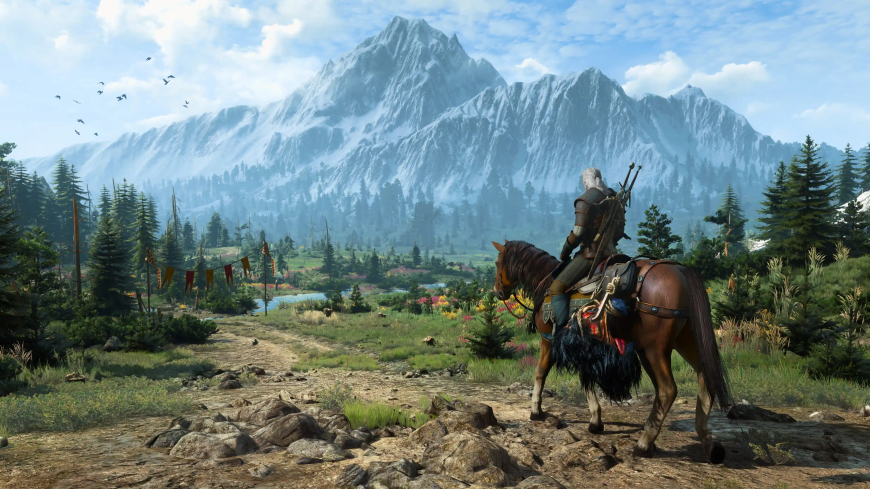
Despite its original 2015 release, The Witcher 3 remains visually impressive, particularly in its updated versions.
The world includes detailed forests, mountains, cities, villages and weather effects.
Day and night cycles also influence the atmosphere.
Fog, rain and storms can dramatically change how locations look.
The game's art direction is especially effective at creating a dark medieval fantasy atmosphere.
Sound and Music
Music plays an important role in the game's atmosphere.
The soundtrack uses different musical styles depending on the region and situation.
Combat music creates tension, while quieter exploration sections can feel more atmospheric.
Environmental sound effects also contribute to immersion.
Horses, weather, wildlife, crowds and combat all create an active soundscape.
The Witcher 3 Expansions
The game received two major expansions:
- Hearts of Stone
- Blood and Wine
Both expansions add substantial content.
Hearts of Stone
Hearts of Stone introduces a new storyline, characters and locations while expanding the game's darker themes.
The expansion focuses heavily on storytelling and difficult choices.
Blood and Wine
Blood and Wine introduces Toussaint, a large new region with a distinctive visual style and culture.
It adds new quests, characters, enemies, equipment and locations.
The expansion is particularly notable for its large amount of content and its strong narrative focus.
The Next-Generation Update
The Witcher 3 later received a major update that improved the game for modern platforms.
The updated version introduced graphical improvements and technical enhancements, while also adding quality-of-life features.
These improvements helped the game remain relevant on newer hardware.
Beginner Tips
New players should avoid rushing through the main story.
Exploring the world can provide useful equipment, experience and additional context.
It is also important to maintain appropriate equipment for Geralt's level.
Players should regularly:
- Upgrade weapons
- Upgrade armor
- Collect crafting materials
- Experiment with Signs
- Use potions
- Apply monster oils
- Complete Witcher contracts
- Explore question marks when useful
- Save before important decisions
The game becomes much easier once players understand how preparation works.
Common Mistakes
One common mistake is treating every enemy as if it can be defeated using the same strategy.
Different monsters require different approaches.
Another mistake is ignoring alchemy.
Potions and oils can provide significant advantages during difficult encounters.
Players can also miss interesting content by following only the main quest.
The Witcher 3 rewards curiosity, so exploring side quests is often worthwhile.
Advantages of The Witcher 3
- Excellent open-world design
- Deep and memorable story
- Strong character development
- Large number of meaningful side quests
- Detailed fantasy world
- Interesting monster encounters
- Flexible character progression
- Excellent expansions
- Strong dialogue and voice acting
- Multiple endings and consequences
- Extensive exploration
- Gwent and other side activities
- High replay value
Disadvantages of The Witcher 3
- Combat can feel less complex than some dedicated action RPGs
- The enormous amount of content can feel overwhelming
- Inventory management can become complicated
- Some animations and controls feel dated compared with newer games
- The main story can take a considerable amount of time to complete
- Some optional map activities can become repetitive
Is The Witcher 3: Wild Hunt Worth Playing?
The Witcher 3 is particularly well suited to players who enjoy open-world RPGs with strong storytelling, exploration and character development.
Its biggest strength is the quality and variety of its quests.
The game does not simply use the open world as a large space between objectives. Locations, characters and side stories often have their own identities and consequences.
Players who enjoy games such as Elden Ring, Skyrim or other large fantasy RPGs can find a substantial amount of content here.